Has this ever happened to you?
I was working on a strategic summary and decided to bring in my favorite AI tool for help. I asked it questions, delegated tasks, and it started generating.
I began reviewing the draft. At first, it looked good. The structure made enough sense. The language was coherent. The grammar was perfect. It seemed close to what I was expecting. But something was off…
So, I reviewed it again. Then again. It took me a while to figure out what was missing. It wasn't a word or a phrase. It was the core idea that I'd been working on. The nuance I'd been wrestling with for days, the thing that made the thought valuable, wasn't there. I read my understanding back into the words, but others wouldn't be able to see it.
The words were there. The thinking wasn't. The words were hollow.
It's the gap between something that sounds good on the surface and something that expresses thinking. And, after experiencing this pattern over and over again, I decided it's time to deal with it in the open.
"The signal" was always human
Let's use Morse code as a quick analogy. The dots and dashes that represent letters aren't the message. They're the signal of the message. The message itself sits in the head of the person on the other end of the line. They thought of something, encoded it, and sent it. You decoded it on your end. The signal carried the message, but the message and the signal aren't the same thing.
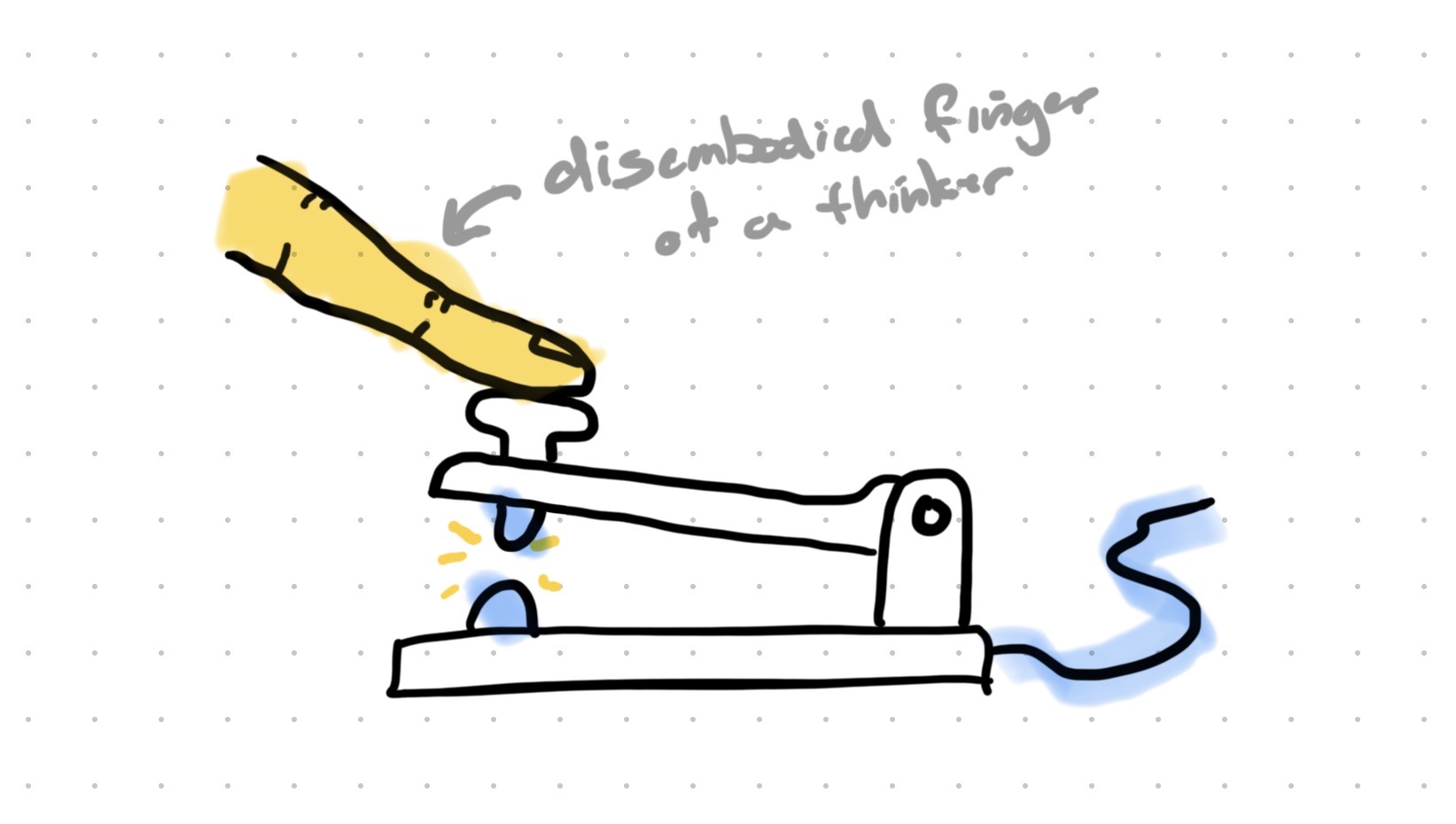
For most of human history, written language was expensive to produce. Ghostwriters existed, but you had to hire one. Speechwriters existed, but politicians and executives had to pay for them. Plagiarism existed, but it required a real author somewhere upstream and the huge risk of getting caught. Even popular phrases that got recycled were obvious to anyone paying attention. The costs and risks kept the signal mostly honest.
Fluent output usually came from a mind because the alternative was hard to pull off at scale. So we built a habit: when you read words you could trust there was human thinking somewhere on the other side.
That habit worked for thousands of years.
Even the hollow words required some thinking. A consultant filling a deck still had to choose which buzzwords. A PM working on a product requirements doc still had to pull together a few bullet points. A designer had to grab some components for a layout. There was always a minimum thinking floor, however shallow. The "thinking floor" was imposed. Produce anything, you had to think…at least a little.
Then, very recently, words got cheap. Words can now come from a system with no understanding, no message, no thinking behind them. AI didn't invent hollow output. It supercharged it, by removing the thinking floor. On the surface, "the signal" of output looks the same. But now, there's no way to tell if the thinking ever happened.
You might think this is a new problem for the 2020s…but, it's not. Alan Turing's test, way back in 1950, offered a way to sidestep the question of whether machines think by reducing it to whether they could have a convincing conversation. The test made language the evidence for thinking. Not because language is thought, but because we didn't have a better test. It worked in a time when language only came from minds. But, that's not the case anymore.
Joseph Weizenbaum's ELIZA in 1966 started poking holes in that test. It was a tiny script that just rephrased people's sentences back at them. It wasn't thinking. It was a clever use of basic grammar rules. People poured their hearts out to it. They believed something was listening. It's the same today with your favorite GPT. The confusion isn't new. Now, the capability is just cranked up to 11.
And we're way beyond simple text. AI-generated images and prototypes typically have a high-quality polish. On the surface that polish makes us assume a human-level intelligence behind the generated artifact. Vibe-coded apps look like working software. Generated images look like the result of someone making choices. Prototypes have the appearance of user-centered thinking. Every kind of output we used to take as evidence that a mind was at work can now arrive without one. We read the high fidelity as a signal of human cognition. And today, that's a huge mistake.
Expression is not always thinking
Before going further, I want to be careful about something. Some kinds of expression are inseparable from thinking. When a designer sketches, they're not just recording an idea they already had. They're working it out in real time. The pencil makes a mark anticipating a fuzzy concept, the eye perceives, the mind interprets, the hand adjusts. The artifact and the mind are in active conversation. The medium talks back. You draw a layout and realize it doesn't work, but the wrong version showed you something the perfect version wouldn't have.
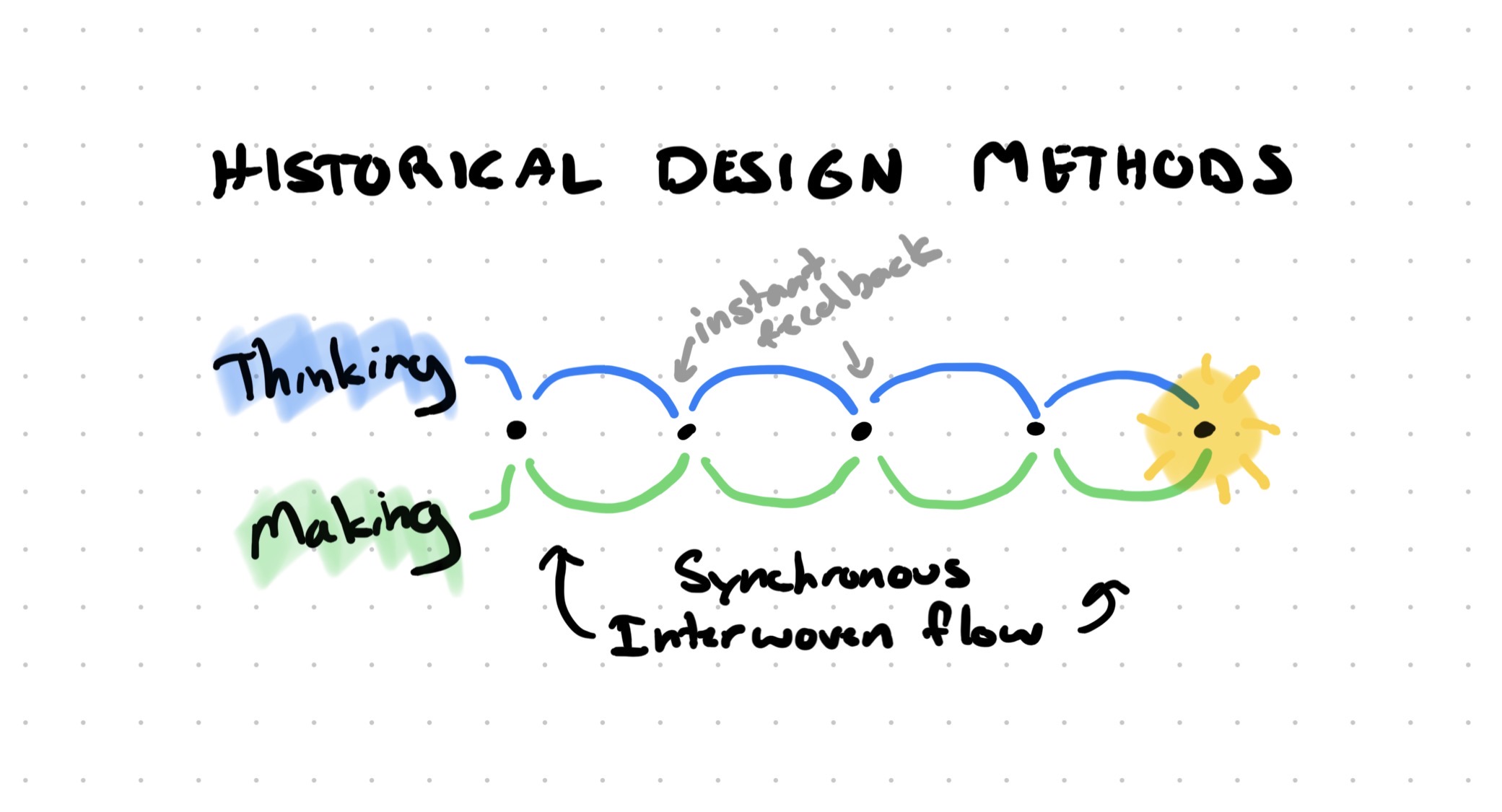
Same goes for writing-to-think, prototyping, or any kind of making where you don't know what you know until the thing is in front of you. The thinking and the expressing happen together. Nigel Cross has written about this same dynamic in how great designers actually work. And Bill Buxton has spent a career making the case for sketching (and making) as a thinking tool.
But that's not the only kind of expression there is. Plenty of thinking happens with no language and no artifact at all.
A baby figures out how to use a cup and a spoon long before they have words for either one. Nobody would say there's no thinking or reasoning happening because there's no vocabulary attached to it. A crow bends a wire into a hook to fish food out of a tube. The bird worked something out. Without a single word.
In our modern society, we attach language to thinking as if they are inseparable. But they aren't.
Here's another angle: Imagine you're in a conversation in English and you reach for a word that you only know in another language. Maybe a perfect word in Spanish or German that doesn't quite translate. The thought is fully formed in your head. You can feel its shape, the necessary nuance. You just can't get it into the language you're speaking. The word is not the thinking. The word is a mere expression of the thinking. The word is an output of thinking.
Michael Polanyi hits this by saying, "we know more than we can tell." Real understanding lives in a place that language reaches toward but never fully contains. The words are a partial export.
Expression that has understanding behind it, shaping the strategic frame, the product value, the user flow, the UI layout, or the lines or the code, is thinking. The other kind isn't expression at all. It's production that looks like expression. There's nothing actually being expressed. It can look identical from the outside. The difference is whether thinking was interwoven with the creation of the artifact. The artifact talking back in real time to the thinker in the midst of its creation.
A system that produces language (English, HTML, etc), with nothing talking back from the inside, is just mere production. It's morse code without a sender. It's production without expression. While these systems are powerful enough to intake context and work in parallel to our thinking, they are not a true expression of any thinking. They are statistical projections of what's baked inside of these LLMs trying to complete an advanced mathematical challenge. They can be a useful tool for a human to express their thinking, but the models themselves aren't expressing any of their own thinking.
"But wait," you might say, "I iterate with AI. I push back. I refine its output." Sure, but notice what's actually happening in that loop. AI isn't thinking. It's creating something that a human is trying to express, based on the human prompt then relying on mathematical probability from its training data and what's statistically likely to come next. It's "mathing" from what you were able to cram into its context. It doesn't think. Only you (the human) does.
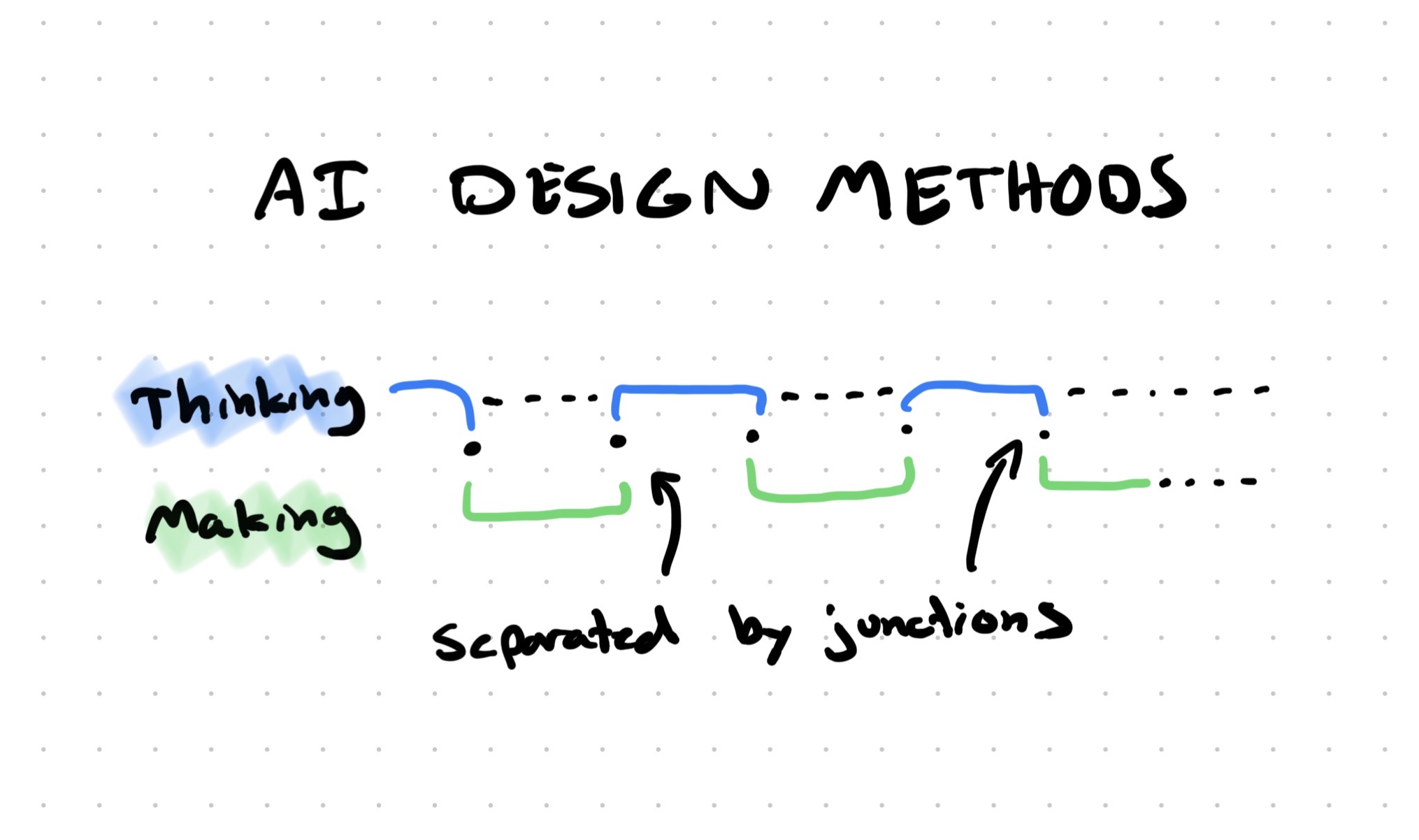
Something like sketching forces friction because the wrong mark stays wrong until you fix it. The pencil doesn't guess what you meant. The paper doesn't fill in the gaps with something plausible. AI removes that friction unless you provide it yourself. The thinking still has to happen in you, or it doesn't happen at all.
Three mirrors of the same misread
Here are three examples of how it plays out.
The leader
A leader sees a document from someone on their team. The writing seems clean. The structure visually apparent. The argument has a flow. They credit the producer with good thinking and reward them for it, with little scrutiny. The polish shows up in performance reviews, hiring decisions, and who gets the next stretch assignment.
Polish was the criteria. Polish used to be expensive. It required thinking, time, care. Now polish is cheap. Thinking, however, is still rare. Now, the leader can't tell from the polish alone which one they're looking at.
The designer
A designer explains a feature they are working on and asks AI to generate a prototype. The result comes back. It looks good. It looks like work they would have mostly done themselves (maybe even better). They feel the relief of having produced something.
But there was no "talk back" when it was created the way an in-progress sketch does. Nothing got wrestled with. No tradeoff was considered. No alternatives were considered and rejected. No gut feeling happened during the assembly. The reassurance of completion arrived without the thinking.
The partner
You get a document from a partner. Maybe a product manager, an engineering lead, or a senior leader. They sent it as their position, their thinking, their direction. You read it and start reasoning against it. You ask questions, critique, and build on what they said. You're treating it as an expression of their thinking, because that's what documents from partners have always been.
Unbeknownst to you, the document is a one-shot output from AI. They prompted it. It generated. They skimmed it. They sent it.
Some parts express how they actually think. But, the AI-filled-in parts represent an average of what it's seen before. You can't tell what's what, but you know it hasn't left the "uncanny valley" of writing. You're reasoning against a position the partner doesn't actually hold and committing real time to refining a direction that came from no one.
But here's where it gets worse. Way worse. They might not be able to tell the difference either.
The prompt was theirs. The skimming felt like reading their own work. They thought "yeah, this captures what I meant". So when you challenge it, they defend it…as their own. Not because they composed it, but because the document feels like theirs. They're now defending a position that AI assembled, and you're now arguing against a person who isn't quite who they think they are.
The AI didn't just fool you. It fooled the person whose name was on the document.
In all three examples, polish gets mistaken for thinking. That's what makes this whole situation tough. It corrupts. It trades thinking for mere production. It conflates something produced as an accurate representation of sound thought. The thinking is absent.
And the work doesn't disappear when the thinking is absent. It just moves. If you're lucky someone downstream, a partner or a teammate or a reviewer, now has to do the thinking that didn't happen (they are the unlucky ones). HBR's recent piece on "workslop" calls this out: output that doesn't carry real thinking just passes the cost along to the next person.
Don't be that person.
Polish Isn’t Proof
So now what? Artifacts can be mass created without any substantial thinking or cognition. Whoop-tie friggin' do.
You can't really tell if thinking happened just by looking at something. We never really needed to. If the words made sense, a mind had been at work. If something as advanced as a photo exists, a human must have created it. If you have working software, people built it. That's what we used to think. Not anymore.
Donald Schön had a helpful concept called "knowing-in-action." The idea is that real expertise often lives in doing (not words). A skilled designer can navigate a wicked problem in a way they can't always fully describe afterward. A good clinician makes a call in five seconds and would need an hour to explain why. The expertise is real. It just resists being put into words.
If we combine Schön with Polanyi's "we know more than we can tell" (from earlier), we realize that knowing lives partly outside of language. The thing that makes someone good at their job is hard to evaluate by merely reading what they wrote or seeing what they made. Because words are never enough. For example, the UX industry has had to invent thousands of terms just to capture shared meaning and we're still going. The meaning existed before the words. The words came after, as shortcuts so we could talk about the meaning that already existed.
You might think I'm splitting hairs, but this is nothing a good shampoo can fix. There's no test on created things that proves or disproves thinking. Words and artifacts are always an attempt at expression of thinking. This is why portfolio reviews are so important to us. We want to "see" + "hear" together to get the best possible understanding of designer thinking.
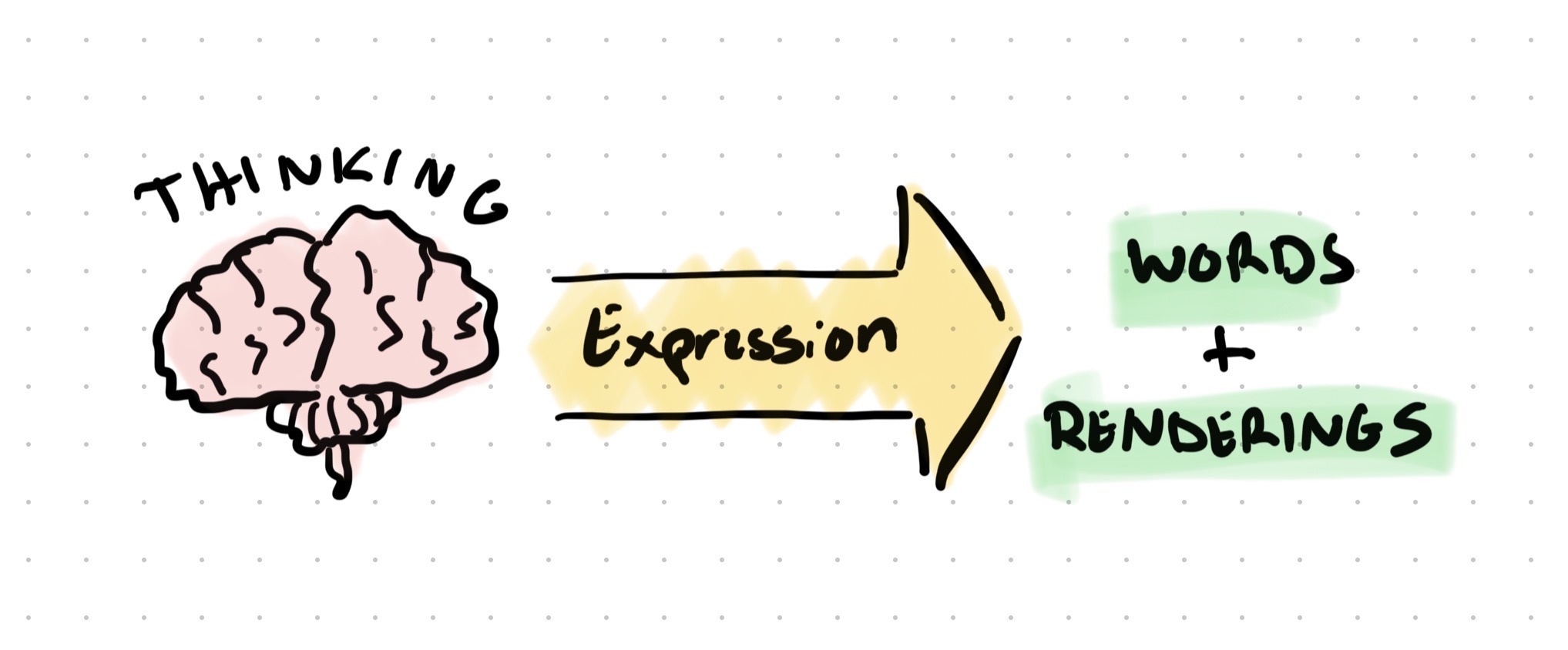
So now, we can no longer rely on what was produced as evidence of thinking. There's a new burden imposed when interacting with any content or artifact. The cognitive burden to ensure things make sense increases. In some cases, the work doubles. The producer has to think harder about what was produced, because so much was created so fast. The reader has to interrogate and pull apart, because polish isn't evidence of thought work anymore. In both cases the "polish" of these words and artifacts are high, but not an indicator of effort.
Polish got cheap. Thinking is still expensive.
Strengthen, don't offload
So what do we do about this? The answer is not to abandon LLM usage. It's not to shame or humiliate those who use it. It's not even to punish those who throw "workslop" or "trendslop" your way.
Start with what LLM tools are. They are (incredibly) advanced word prediction machines. They aren't thinking. They create something that looks like an expression of human thinking. It calculates based on your prompt, their training data, and what's statistically likely to come next. The thinking has to come from you. The AI is just elaborating on your input based on what it's seen before. That attempt can be useful. It produces output with the illusion of thinking that was never there, because it's been trained to mimic the output that human thinking produces.
Mechanically, they're statistical programs designed to reproduce common patterns. This isn't an attack, it's a functional description. They've been fed an enormous amount of what humans have written and created. So they generate bit after most-likely-next-bit based on what they've seen. The output, by design, tends toward the average of the source material.
This isn't just my opinion either. HBR's Beware the Agentic Convergence Trap argues that AI systems trained on the same data and pointed at similar goals converge to the same decisions, eroding the differentiation companies actually compete on. HBR researchers have also flagged something called "trendslop": LLMs systematically generating buzzword-laden, socially-desirable strategic "advice" because that's what the average of the internet looks like at the time of training. These observations have led to the naming of what's happening: Slop (short for sloppy, or without critical thinking).
Once you accept that these tools produce the statistical norm, you can approach them better. Sometimes the norm is exactly what you need. Sometimes it's the worst thing you could use. Knowing (thinking about) which is which is the human skill we desperately need more of today.
- Use it where the norm is the goal. Baseline summaries. Typical structure. A starting point you're going to push against. The "most common version" as a check on whether you're actually saying something different. These are real, useful jobs.
- Avoid it where going past the norm is the goal. Unique strategy. The hard tradeoff. The wicked problem. The place where the right answer hasn't been written yet, so the average of everything written can't possibly contain it. If you ask the average for something uncommon, you'll get an answer to an already solved problem. (And, this is where design tends to play most.)
- Make the AI show its "reasoning". Not to verify it thought (it didn't), but to force you to evaluate the bit-by-calculated-bit chain of output. Ask it to explain what it did. Look for what it didn't include. This helps ensure that thinking has happened, where it needs to…in your head.
- Treat drafts as material to interrogate, not deliverables to accept. The polish is not proof of thinking or quality. Read every paragraph and ask: would I want to defend this claim if someone pushed back? Could I explain why this is the right call? If not, it isn't yours yet.
The point of all of this is one thing: Strengthen your thinking. Don't skip it.
Whew, that was a lot.
These tools aren't going anywhere (unless we see an unparalleled collapse). They'll keep getting better, more confident, more polished and higher detail. (Just look at Fable) The output signal will keep mimicking a sender with thinking behind it. Don't be fooled. It's just mimicry.
The work in front of us has two halves. For the producer: you must think. Don't let polish create an illusion of something you didn't do. For the reader: interrogate. Don't let polish fool you into lazy acceptance. Both follow from the same fact. No one can read thinking from an artifact anymore.
The signal used to be relatively honest. It isn't anymore. So the next time you hear the tap-tap-tap of Morse code, get your thinking cap on. Judge for substance. Not the signal of production.